Research Topic
- Home
- Research
- Research Topic
Oxide Semiconductor Device
To break through conventional semiconductor limitations and achieve innovative performance, oxide semiconductors are being studied for memory, logic, power, and photoelectronic devices in research and industrial applications.
Oxide Semiconductor based Power device
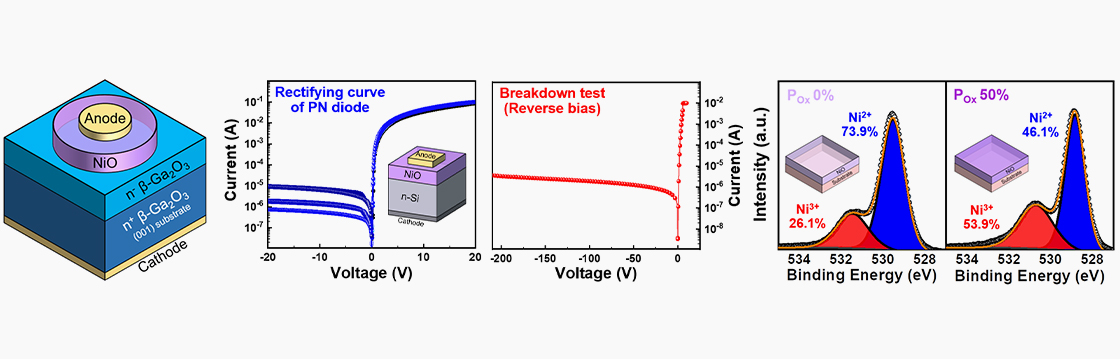
Recently, the demands for ultrahigh power semiconductor such as high voltage direct current (HVDC) transmission systems, data centers, and industrial motor drive system applications are expanding. In line with this trend, conventional SiC/GaN power electronics are facing performance limits due to their fundamental properties. To overcome this challenge, Beta gallium oxide (β-Ga₂O₃) is emerging as a promising material for next generation high voltage power devices due to its ultra-wide bandgap (UWBG) about 4.8 eV. However, the absence of p-type remains a major bottleneck to fabricate advanced bipolar power devices. Therefore, research on p-type oxide material is required to develop bipolar power device based on WBG oxide semiconductors, which can withstand a higher voltage with lower leakage current.
Oxide Semiconductor based Photo device
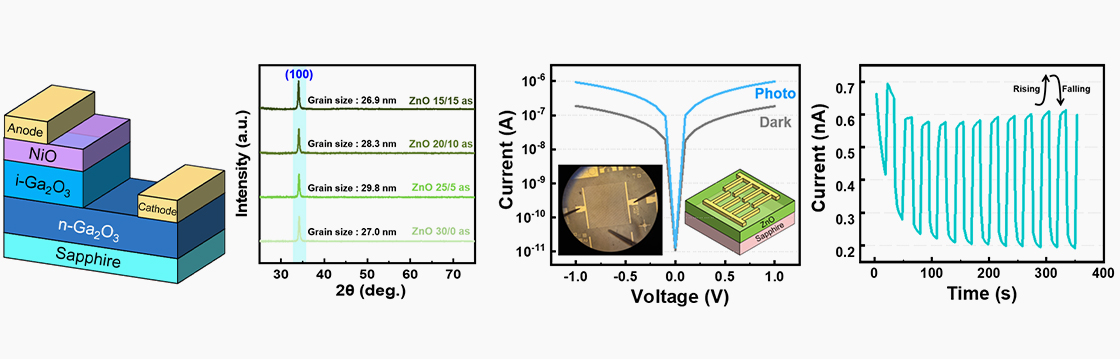
Ultraviolet (UV) photodetection has drawn a great deal of attention in recent years due to a wide range of civil and military applications, such as space-to-space communications, pollution monitoring, flame sensing and missile plume detection. Because of its wide bandgap, strong radiation hardness and high chemical stability, Oxide semiconductors are regarded as one of the most promising candidates for UV photodetectors. Among them, we are researching photodevices based on WBG oxide semiconductors such as NiO, ZnO and β-Ga₂O₃. Photodevices with novel architecture through modulation of film properties and metal electrode engineering are expected to perform enhanced photo-response and UV detection capability.